
Artificial intelligence has quickly become part of everyday work, education, content creation, research, and business. Among the many AI assistants available today, ChatGPT remains one of the most recognizable and widely used options.
But is ChatGPT still worth using in 2026?
In this review, we look at what ChatGPT offers, its main features, pricing considerations, strengths and weaknesses, and who can benefit most from using it.
What Is ChatGPT?
ChatGPT is an AI assistant developed by OpenAI. It can help users generate and edit text, answer questions, summarize information, brainstorm ideas, analyze content, assist with coding, and complete a wide range of productivity tasks.
Instead of using a separate application for every task, users can interact with ChatGPT using natural language.
This makes it useful for everyone from students and freelancers to marketers, developers, entrepreneurs, and business teams.
Key ChatGPT Features
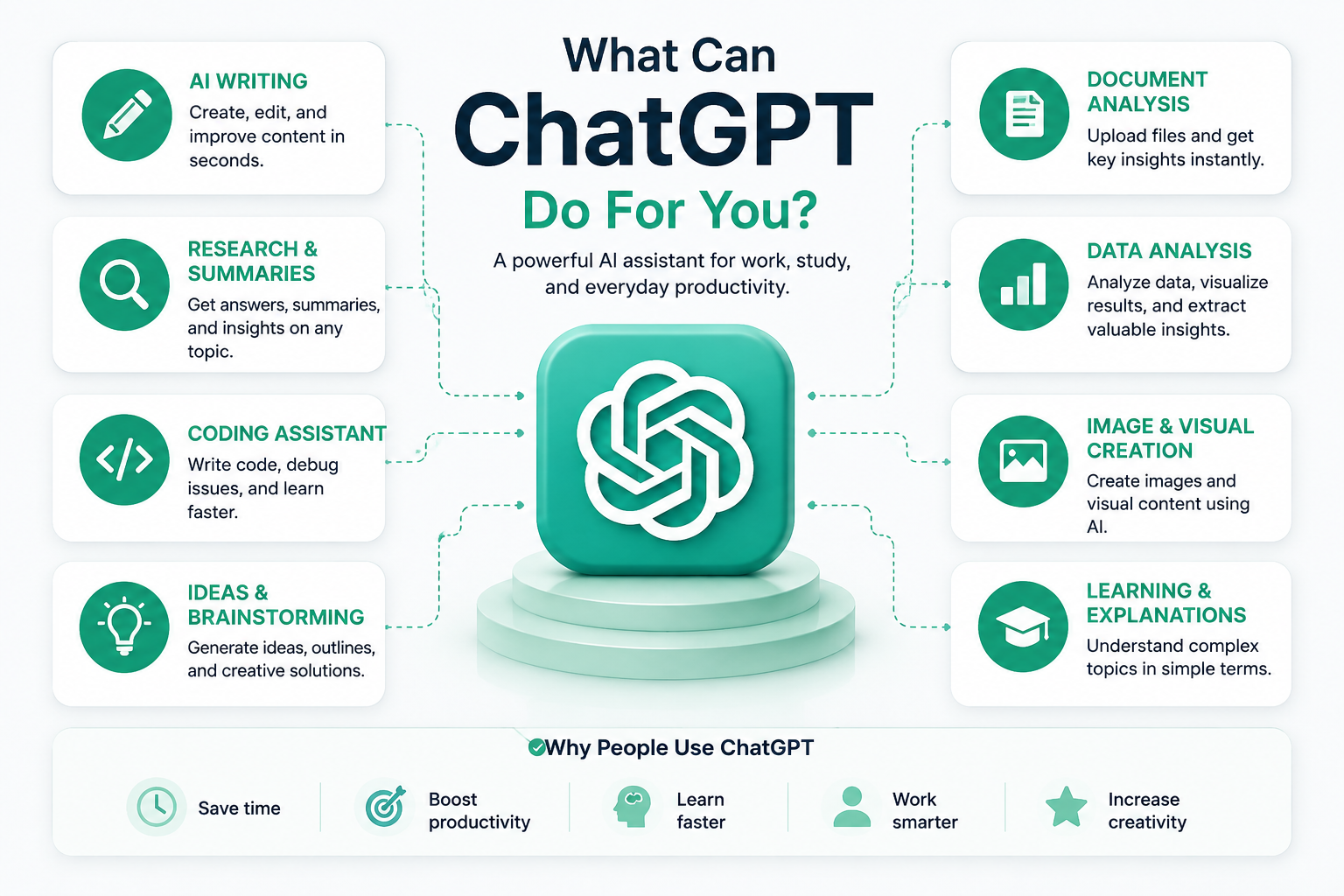
1. AI Writing and Editing
ChatGPT can help create articles, emails, social media posts, product descriptions, outlines, scripts, and other types of written content.
It can also rewrite existing text, change the tone, shorten content, improve clarity, and help organize ideas.
2. Research and Information
ChatGPT can help users understand complex subjects, organize information, compare options, and explore ideas.
For research-heavy tasks, users should still verify important information against reliable sources, particularly when accuracy is critical.
3. Coding Assistance
Developers can use ChatGPT to explain code, identify potential problems, generate examples, and assist with programming tasks.
It can be useful for both beginners learning programming and experienced developers who want to speed up routine work.
4. File and Data Analysis
Depending on the available ChatGPT plan and features, users can work with files and data directly in ChatGPT.
This can make tasks such as analyzing documents, extracting information, working with datasets, and understanding reports much easier.
5. Image and Creative Tasks
ChatGPT can also be used for creative workflows involving images and visual ideas.
This makes it useful for marketers, content creators, designers, and businesses that need to move quickly from an idea to a finished concept.
6. Productivity
One of ChatGPT’s biggest advantages is its flexibility.
Instead of learning a complicated interface, users can simply describe what they want to accomplish and refine the result through conversation.
For example, ChatGPT can help with:
- Writing emails
- Creating business documents
- Brainstorming ideas
- Creating content plans
- Summarizing documents
- Learning new subjects
- Creating presentations
- Generating marketing ideas
- Analyzing information
- Writing and explaining code
ChatGPT Pricing
ChatGPT offers different levels of access, with features and usage limits depending on the plan available to the user.
The free option can be useful for casual users who want to experiment with AI without committing to a subscription.
Paid plans are designed for users who need higher usage limits and access to additional capabilities.
Because AI products and pricing can change frequently, it is worth checking the official ChatGPT pricing page before subscribing.
ChatGPT Pros and Cons
Pros
- Easy to use
- Wide range of applications
- Useful for writing and brainstorming
- Can assist with coding
- Helpful for research and learning
- Useful for businesses and freelancers
- Supports many different workflows
- Continues to receive new features and improvements
Cons
- AI-generated information can sometimes be incorrect
- Features and limits depend on the plan
- Some advanced capabilities may require a paid subscription
- Users still need to review important outputs
- Results can vary depending on the quality of the instructions provided
Who Should Use ChatGPT?
ChatGPT can be particularly useful for:
Students
Students can use it to explain difficult concepts, brainstorm ideas, summarize material, and practice learning.
Freelancers
Freelancers can use ChatGPT for emails, proposals, content creation, research, brainstorming, and administrative tasks.
Small Businesses
Small businesses can use AI to help with marketing content, customer communication, planning, research, and everyday productivity.
Content Creators
Bloggers, YouTubers, social media creators, and other publishers can use ChatGPT to generate ideas, outlines, scripts, titles, and content concepts.
Developers
Developers can use ChatGPT as a programming assistant for explanations, debugging, documentation, and code generation.
Is ChatGPT Easy to Use?
One of ChatGPT’s strongest advantages is its relatively simple interface.
Users do not need to understand complicated commands to get started. They can simply describe the task they want to complete and continue the conversation to improve the result.
However, learning how to write better prompts can significantly improve the quality of the output.
A vague request may produce a generic answer, while a detailed prompt containing context, goals, constraints, and examples can produce a much more useful result.
ChatGPT vs Traditional Software
Traditional software usually requires users to learn specific menus, tools, and workflows.
ChatGPT takes a different approach.
Instead of selecting a function from a menu, users can describe the desired result in natural language.
This makes AI assistants particularly interesting for people who want to automate or accelerate tasks without learning multiple specialized applications.
However, ChatGPT does not necessarily replace specialized software.
For example, a professional accounting application, video editor, project management platform, or graphic design program can still provide specialized functionality that an AI assistant cannot fully replace.
Is ChatGPT Worth It in 2026?
For many users, ChatGPT can be a valuable productivity tool.
Its biggest advantage is versatility. A single AI assistant can support writing, research, learning, coding, brainstorming, analysis, and many other workflows.
Whether a paid plan is worthwhile depends on how frequently you use ChatGPT and whether the additional features and usage limits provide enough value for your needs.
For occasional users, the free option may be sufficient.
For professionals, creators, developers, and businesses that use AI regularly, a paid plan may provide significantly more value.
Final Verdict
ChatGPT remains one of the most versatile AI assistants available in 2026.
Its combination of conversational interaction, writing assistance, research capabilities, coding support, analysis, and creative functionality makes it useful across a wide range of users and industries.
The main limitation is that AI output should not automatically be treated as accurate or authoritative. Important information should always be checked before it is used for professional, financial, legal, medical, or other high-stakes decisions.
Our verdict: ChatGPT is an excellent general-purpose AI assistant for users who want one flexible tool for multiple productivity and creative tasks.
Rating
Overall: 4.7/5
- Ease of Use: 5/5
- Features: 5/5
- Versatility: 5/5
- Value: 4.5/5
- Specialized Workflows: 4.5/5
Frequently Asked Questions
Is ChatGPT free?
Yes. ChatGPT offers a free option, while paid plans provide additional features and higher usage limits.
Is ChatGPT worth paying for?
It depends on how frequently you use it. Regular users who need additional capabilities and higher limits may find a paid plan worthwhile.
Can ChatGPT write articles?
Yes. ChatGPT can help with article ideas, outlines, drafts, editing, rewriting, and content planning.
Can ChatGPT help with coding?
Yes. It can explain programming concepts, generate code examples, help identify errors, and assist with development tasks.
Is ChatGPT accurate?
ChatGPT can provide useful and accurate information, but it can also make mistakes. Important information should always be independently verified.
Who is ChatGPT best for?
ChatGPT is useful for students, professionals, freelancers, creators, developers, entrepreneurs, and businesses looking for a flexible AI productivity assistant.